Keeping Medaka Without a Filter: Japan's Low-Tech Method
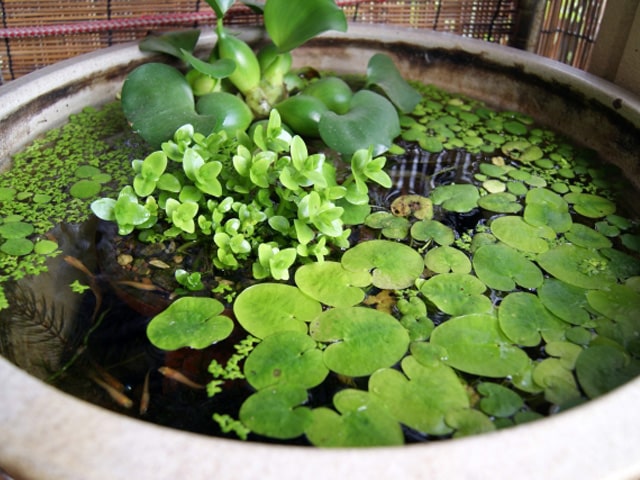
In Japan, the standard way to keep medaka outdoors is a bowl or tub set up as a small biotope, and it can run with no pump and no filter. At its simplest it is a wide bowl, some pondweed, a few rice fish, and sunlight doing the filter's job.
The method works in almost any wide outdoor container, and for a few fish in a jar indoors. A standard indoor glass aquarium is the hardest place to go pumpless, and there is little to gain from trying. US hobbyists will recognize parts of this from Walstad-style no-filter tanks; the Japanese version works mainly because medaka are so hardy.
- Medaka are hardy, tolerate low oxygen, and do not foul water quickly. That is why they can be kept this way.
- Outdoors is easier than indoors. Sunlight grows the plants and bacteria that replace the filter, and a wide, shallow container takes in oxygen more easily than a deep, narrow one.
- Three outdoor containers: a bowl run biotope-style with substrate and plants, a mortar tub run bare-bottom, and a foam box for insulation in summer and winter.
- In a biotope, wait 7 to 10 days after filling before any animal goes in. Then add two or three hardy medaka as pilot fish and hold at that number for about a month.
- Plants such as hornwort and frogbit, a few shrimp and snails, and partial water changes when needed do the work a filter would.
Why It Works Without a Filter
Medaka (メダカ, the Japanese rice fish) are not fussy about water quality and tolerate low oxygen well. They also produce little waste.
A filter does two jobs: it moves water so the surface takes in oxygen, and it houses the bacteria that break down waste. In a pumpless setup, the container and what grows in it do both. Oxygen dissolves through a wide opening on its own, while the bacteria live in the substrate instead of a filter and plants take up the leftover nitrate, adding oxygen as they photosynthesize. Bacteria and plants both grow faster in sunlight, so outdoor containers do better than indoor ones. As our staff aquarists put it, once a biotope is established and keeping itself clean, you may hardly need water changes at all, depending on how many fish you keep.
Nothing needs an outlet, and there is no filter to clean. What trips people up is choosing a container whose shape keeps oxygen out of the water, or skipping water changes and cleaning.
Choose the Container First
Shape and location decide how easily oxygen gets in and how fast the water fouls, so this choice comes before anything else.
Bowls on the patio
Popular choices are the suiren-bachi (睡蓮鉢, "water lily bowl") and the resin medaka bowl; a standard resin bowl sold in Japan holds about 3 gallons (12 liters). A glazed planter with no drainage hole, or a patio pond bowl, does the same job in an American yard as long as the mouth is wide.
Run it as a biotope: substrate, plants rooted in it, fish added later.
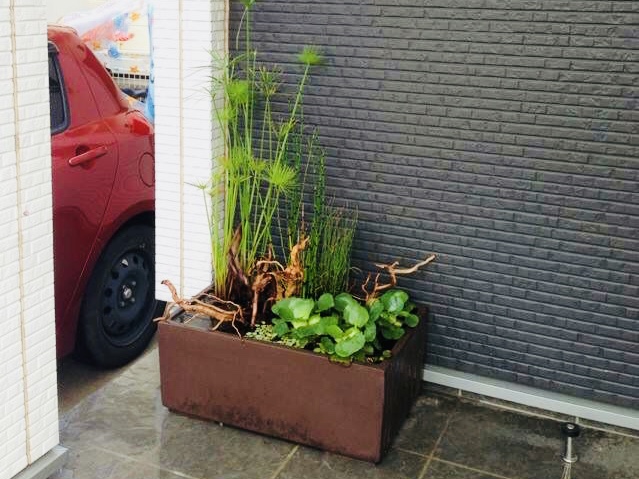
Mortar tubs
The torofune (トロ舟) is a plastic mortar-mixing tub, the same thing American hardware stores sell for concrete. The advantage is volume. Even a small 5-gallon (20-liter) tub holds more than the bowl above. The opening is so wide that oxygen is rarely a problem even without plants. Many keepers run tubs as biotopes too, but for a torofune the style we recommend is bare-bottom, with no substrate at all. Waste has nowhere to hide, so when droppings show, do a partial water change and clean it out.
An outdoor bare tub also tends to turn green. That is aomizu (青水), water full of phytoplankton, and it is good for medaka, since adults and newly hatched fry both eat it. Green water that gets too dense can starve the fish of oxygen. When you can no longer see the bottom, thin it with a water change. Float some plants on top for shade and hiding places.
Foam boxes for heat and cold
A foam shipping box or foam cooler can be run either way, biotope or bare. Because foam insulates, the water temperature stays steadier through summer heat and winter cold, and the box is light and cheap. The wide opening means oxygen is not a worry. Bowls look better and plastic tubs are stronger, though, so foam works best as a seasonal container to get through the peak of summer or a freeze.
A jar on a shelf indoors
Indoors there is less sunlight, so plants and bacteria do less and you keep the water clean by hand. A small jar or vase, the Japanese "bottle aquarium," usually runs without equipment because little is made to fit it. The opening is narrow and the volume tiny, so keep it to a few medaka and change some water at least once a week; clean it whenever algae spoils the view.
Why an indoor glass tank struggles
For pumpless keeping, this is the one to avoid. A glass tank is deep for its surface area, so oxygen dissolves poorly. Heavy planting can supply it, but then you need a plant light. Without a pump the water stagnates and waste builds up, and you end up siphoning the bottom almost every day. The exception is fry and juveniles, which need few water changes and are better off without current anyway.
The Method, Step by Step
1. Fill, plant, and wait
Fill with dechlorinated water. Add substrate and rooted plants for a biotope, or potted or floating plants for a bare tub. For a biotope, wait 7 to 10 days before any animal goes in, so bacteria can settle in the substrate and the plants can root.
2. Start with pilot fish
Seed a new container with pilot fish (パイロットフィッシュ): hardy fish whose droppings feed the bacteria and whose behavior tells you whether the water is ready. Medaka can be their own pilot fish. Begin with two or three hardy fish such as the black, wild-type kuro medaka, watch them for about a month and, if all is well, add fish and varieties gradually.
3. Let plants do the filtering
Without a filter, you cannot skip plants. They are what keeps droppings and uneaten food from fouling a small volume. In a biotope, root them in the substrate; in a bare tub, use potted plants or floaters. These four grow without being planted, so they suit any style:
- Hornwort, matsumo (マツモ). The main plant for oxygen and clean water. Native across the US and widely sold.
- Anacharis (アナカリス). Restricted in some states.
- Water hyacinth, hoteisou (ホテイソウ). A large floater. Illegal in several US states.
- Amazon frogbit (アマゾンフロッグビット). A smaller floater.
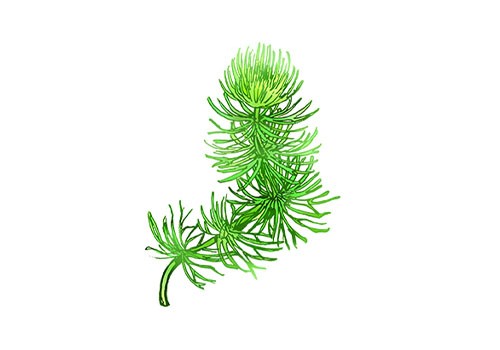
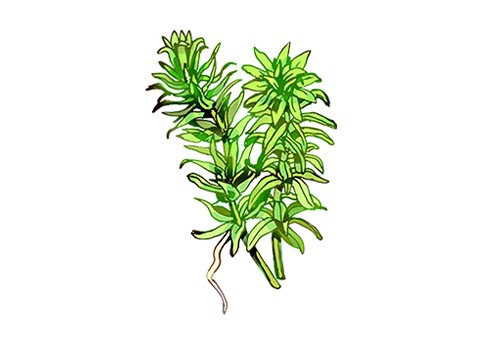
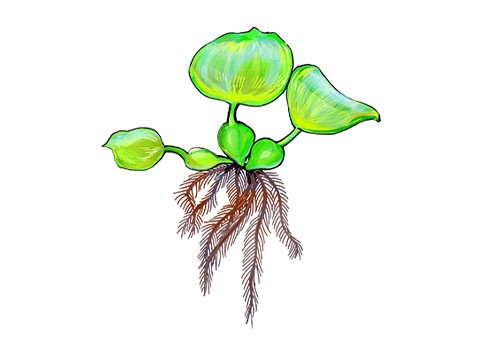
Three of the four plants above. None needs planting. Illustrations by Satoko Nakajima.
4. Add a cleanup crew
Shrimp handle leftover food, plant scraps, and algae. The Japanese choice is the minami-numa-ebi (ミナミヌマエビ), which leaves plants alone and keeps its own colony going; in the US, cherry shrimp do the same job from spring to fall, but bring them indoors for winter.
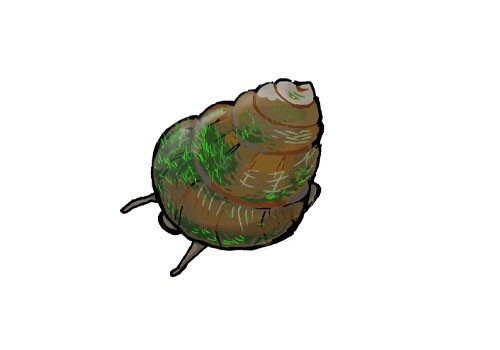 Japanese keepers add the hime-tanishi (ヒメタニシ), a pond snail that grazes algae and also filter-feeds suspended organic matter out of the water, which slows fouling and keeps green water from getting too thick. It multiplies easily, so start with one to three. In the US, the related Japanese trapdoor snail is sold; see medaka tank mates for the state rules.
5. Keep the bottom clean
In still water, droppings and leftover food stay where they fall, and medaka weaken if the water is left to foul. In a bare tub or an indoor container, siphon the bottom clean as part of each water change. A settled biotope bowl needs this only rarely.
How Often to Change the Water
Plants and a cleanup crew still need help from partial water changes (mizukae, 水換え). How often depends on the container:
- Mature biotope bowl: rarely, if the system is working and the fish count is modest.
- Bare tub: whenever droppings show on the bottom, and whenever green water gets too dense to see through.
- Indoor jar: at least once a week, plus a cleaning whenever algae builds up.
Use dechlorinated water every time. When a pumpless container keeps running short of oxygen, the likely causes are its shape, too many fish for the volume, or green water that has grown too dense.
Through the Seasons
Outdoors, heat is the summer problem. Floating plants such as water hyacinth and Amazon frogbit, where they are legal in your state, keep the water shaded. When a heat wave or a freeze is coming, move the fish into a foam box until it passes.
Next Steps
For the bowl-on-the-patio version, The Japanese Container Pond covers the build, including a USDA zone guide for winter.
If your tub has already gone green, How to Culture Green Water shows how to use it rather than fight it.